Why Prayer Apps Show Different Times
Open two apps and Fajr is ten minutes apart. It is not a bug. Here is how salah times are really calculated, and which one to trust.

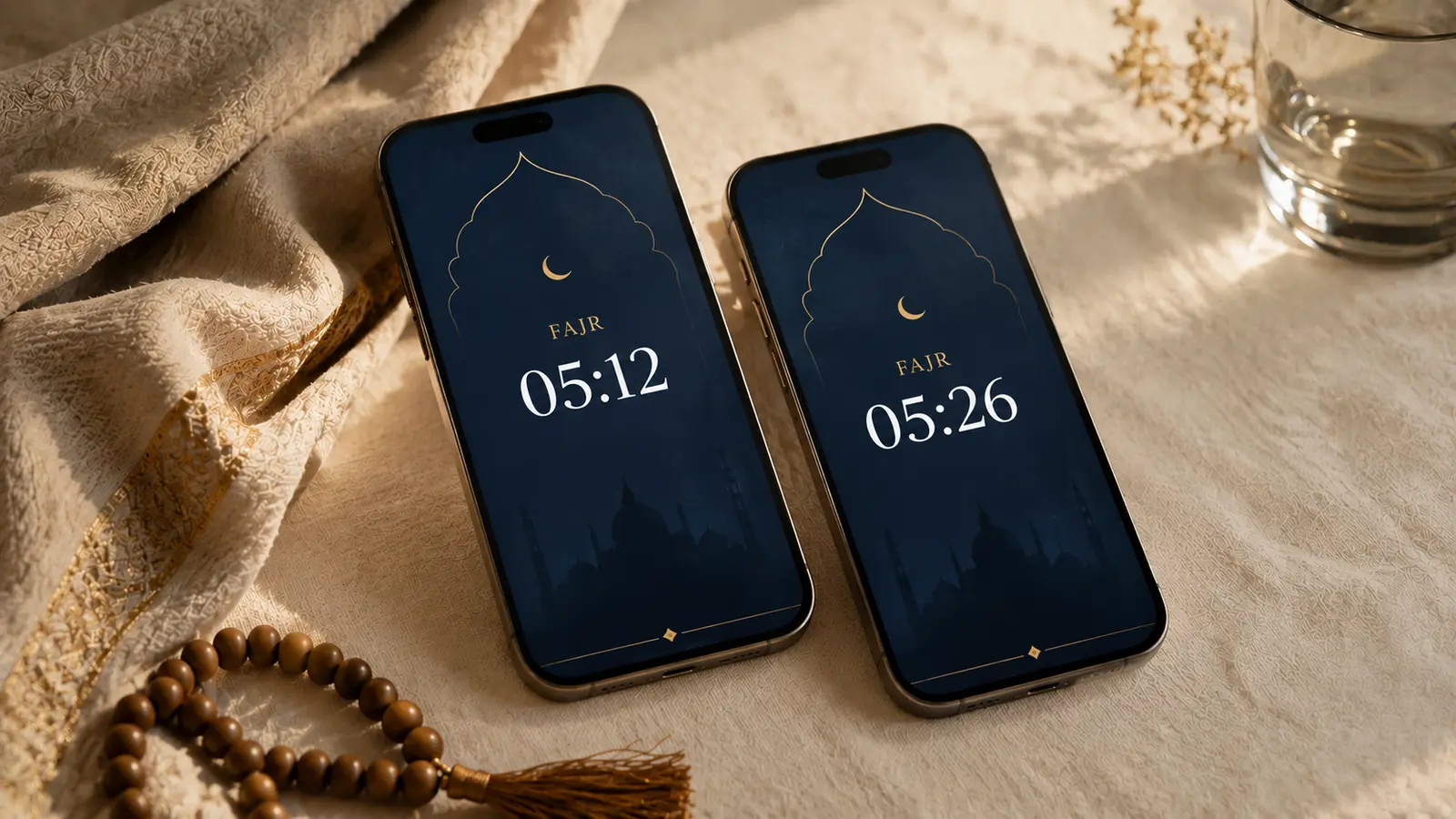
You open one prayer app and Fajr is at 5:12. You open another and it says 5:26. Same city, same morning, fourteen minutes apart. It is enough to make you wonder which one to trust, or whether one of them is simply broken. The reassuring answer is that neither is. Prayer times are not pulled from a fixed table, they are calculated, and a few honest choices inside that calculation are why two good apps can land on different minutes.
Prayer times are calculated, not looked up
Every prayer time traces back to one thing, the position of the sun in your sky. From your exact latitude and longitude, an app works out when the sun reaches its peak, when it sets, and how far below the horizon it sits at dawn and dusk. Dhuhr is just after the sun passes its highest point. Maghrib is at sunset. The rest depend on angles and shadows, and that is where apps begin to differ. Get your location even slightly wrong and every time shifts, which is the first reason two phones can disagree.
Fajr and Isha: the twilight angle
Fajr begins at true dawn, and Isha when the red glow of dusk disappears. But how far below the horizon is the sun at those exact moments? There is no single agreed number, and different bodies have settled on different angles. The Muslim World League uses eighteen degrees for Fajr and seventeen for Isha. ISNA, common across North America, uses fifteen and fifteen. Umm al-Qura in Makkah uses a fixed ninety minutes after Maghrib for Isha rather than an angle at all. Each is a considered position held by serious scholars, and each produces a slightly different Fajr and Isha. This is why those two prayers vary the most from one app to the next.
Asr: your madhab
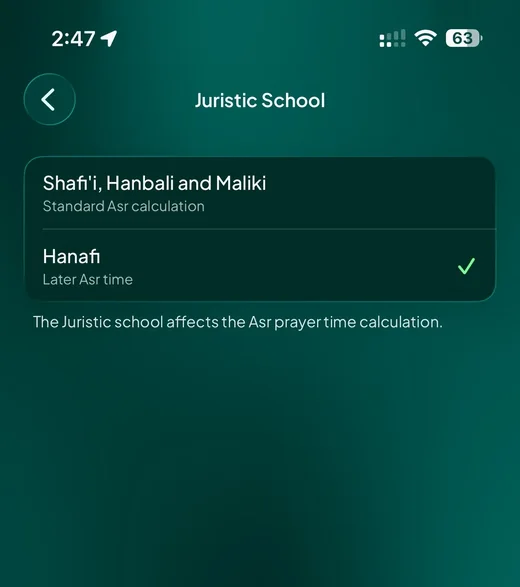
Asr is the clearest split of all, and it has nothing to do with angles. It is about the school of fiqh you follow. The majority of schools, Shafi'i, Maliki and Hanbali, hold that Asr begins when the shadow of an object equals its own length. The Hanafi school holds that it begins when the shadow reaches twice the object's length. That second condition is met later in the afternoon, often by thirty to sixty minutes. So if a friend's app shows Asr much later than yours, the most likely reason is simply that one of you is set to the Hanafi calculation and the other is not.
The smaller adjustments
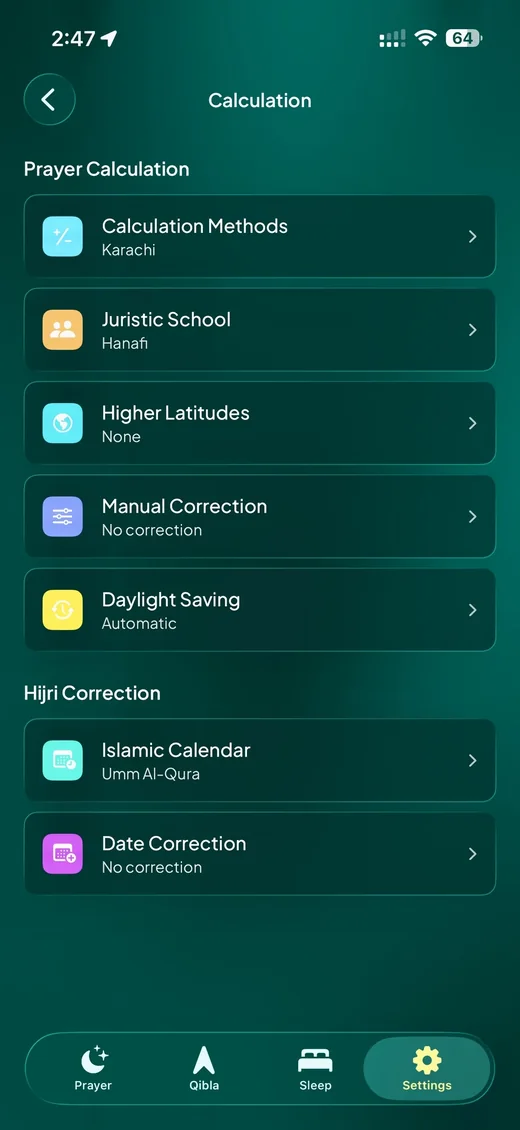
A few other settings nudge the numbers. In far northern or southern places, twilight can stretch through much of the night in summer, so apps apply high latitude rules to give a sensible Fajr and Isha rather than none at all. Elevation, a small safety margin added to a prayer, and rounding to the nearest minute all move things by a little. None of these are mistakes. They are reasonable choices made to fit real places, and a careful caution about praying inside the correct window.
So which time is right?
The honest answer is that there is no single right minute for everyone. The better question is which method and madhab match your community. The simplest rule is to follow your local mosque, because praying in step with the people around you matters, and to use the calculation method your region's scholars have adopted. ISNA across much of North America, the Muslim World League in many places, Umm al-Qura in Saudi Arabia, Karachi for much of South Asia. Choose once, to match where you are, and then stop second guessing the minutes.
How Athanify keeps you on the right method
This is exactly why a good prayer app should let you choose rather than decide for you. Athanify carries every major calculation method and both Asr definitions, and it recommends the right one based on your region so most people never have to think about it. If you follow the Hanafi madhab, you set it once and every Asr is calculated that way. If your mosque uses a particular method, you match it and your times fall in line with the jamaah. The accuracy starts with your precise location, the same coordinates that point you to the Qibla, and the method you pick does the rest.
The takeaway
Different times across apps are not a sign that one is wrong. They are a sign that prayer times are a careful calculation with a few honest choices inside them. Set your method and your madhab to match your community, trust it, and let the small differences go.
Prayer times are not a number to look up. They are the sun, your place on the earth, and a choice your community has already made.
Common questions
Why do two prayer apps show different times?
Because prayer times are calculated, not looked up, and a few choices in that calculation differ. Fajr and Isha depend on the twilight angle, which various authorities set differently. Asr depends on your madhab, since the Hanafi school begins it later than the others. Add a slightly different location or high latitude rule and two good apps can land minutes apart.
Which calculation method should I use?
Use the method your local community and region have adopted, so your times line up with your mosque. ISNA is common across much of North America, the Muslim World League is widely used, Umm al-Qura is used in Saudi Arabia, and the University of Islamic Sciences Karachi is common in South Asia. Set it once to match where you are.
Why is the Hanafi Asr time later than other schools?
Because the Hanafi school holds that Asr begins when an object's shadow reaches twice its length, while the Shafi'i, Maliki and Hanbali schools begin it when the shadow equals the object's length. The second condition is met later in the afternoon, so the Hanafi Asr is later, often by thirty to sixty minutes.
 Conclusion
Different is not wrong
When two apps disagree about Fajr, neither is broken. They have been given different twilight angles, possibly a different madhab for Asr, and at high latitude a different rule for what to do when the sun never dips far enough.
Set yours to match the mosque you actually pray at, then stop comparing. The minutes between one credible method and another are not the thing that determines whether your prayer is accepted, and treating them as if they were is a distraction from the prayer itself.


Keep reading

Senior iOS engineer and the founder of Athanify. Over six years he has shipped sixteen apps on the App Store to users in more than fifty countries, with deep work in Apple's Screen Time framework, payments, encryption and on device AI. He built Athanify on his own, from the first sketch to launch, and writes here about praying well in a world full of screens.