How to Find the Qibla Direction at Home
Work out exactly which wall of your home faces the Kaaba, check it against the sun, and mark it once so you never have to guess again.

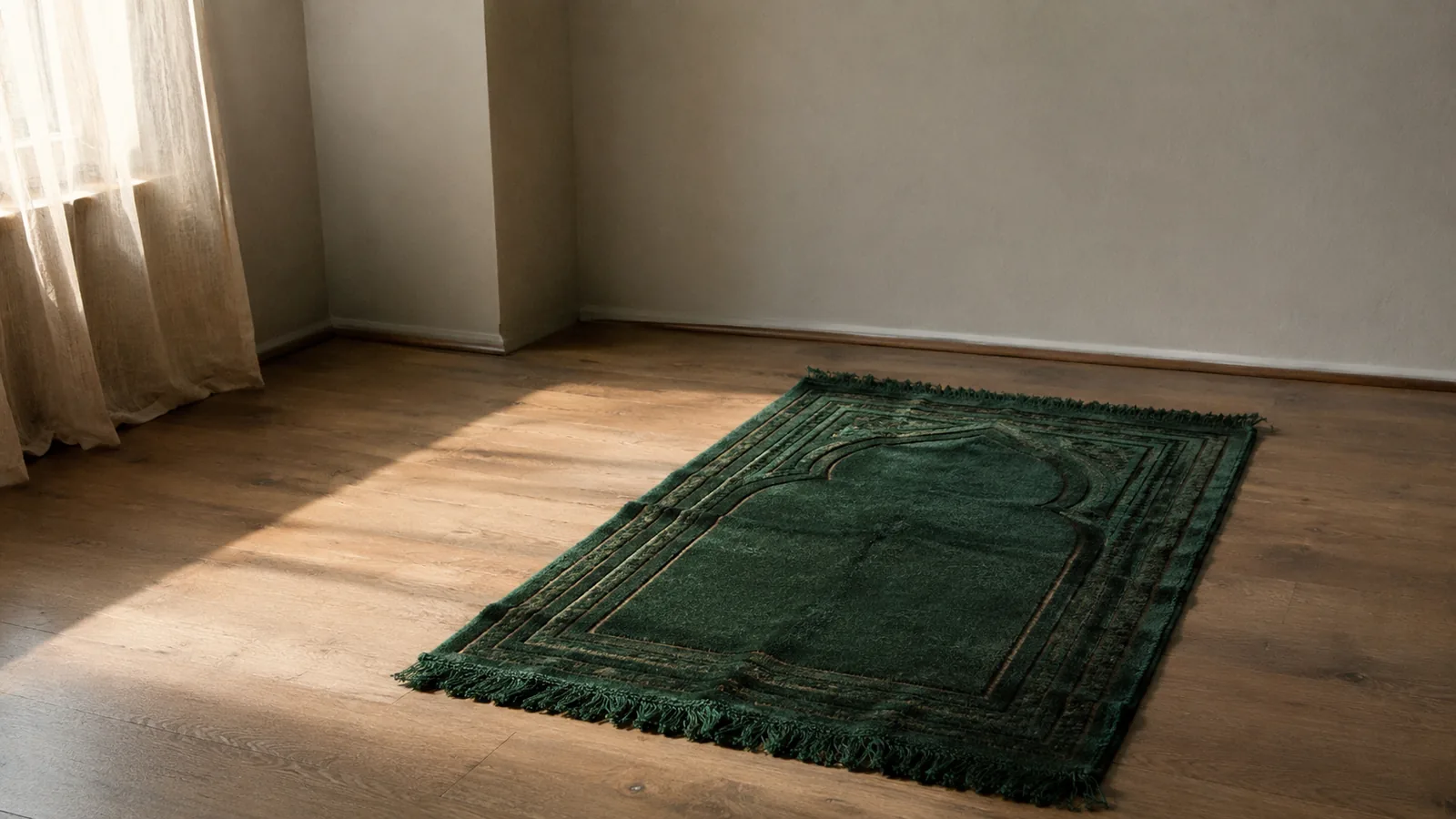
Most people who look this up are not lost in an unfamiliar city. They are standing in their own living room, about to pray, quietly unsure whether the wall in front of them is really the right one.
It is a question worth settling properly, once. Here is how to find the Qibla from your house, how to verify it without trusting any device, and how to mark it so the doubt never comes back.
First: the Qibla is a bearing, not a place
"Where is the Qibla" has no universal answer, and that is the thing that confuses people. The Qibla is not a fixed compass point like north. It is the direction from your specific location to the Kaaba, so it is different for every house on earth.
From London it runs roughly south east. From New York, north east. From Jakarta, west north west. From Cape Town, north north east. Two people a thousand miles apart face genuinely different directions and both are correct.
There is a second subtlety that catches people out. The shortest path between two points on a globe is a great circle, and on a flat map a great circle looks like a curve rather than a straight line. This is why the Qibla from North America points north east, which feels wrong to anyone picturing a flat world map with Makkah over to the right. Aim across the top of the globe, not across the paper.
The reliable method: coordinates, not magnets
The most accurate way to find the Qibla at home is a Qibla app that computes the great circle bearing from your GPS coordinates to the Kaaba. Because the maths runs on position rather than on a magnetic sensor, it does not care that you are indoors, surrounded by walls, wiring and furniture.
Open the app in the room you actually pray in. Stand where you would stand. Turn until the indicator aligns. That is your Qibla.
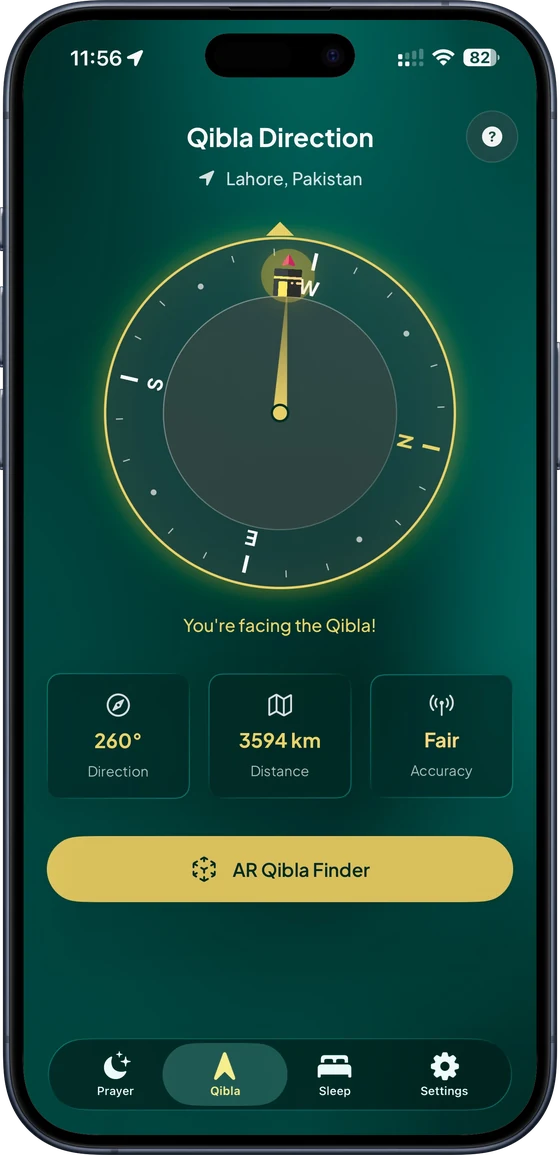
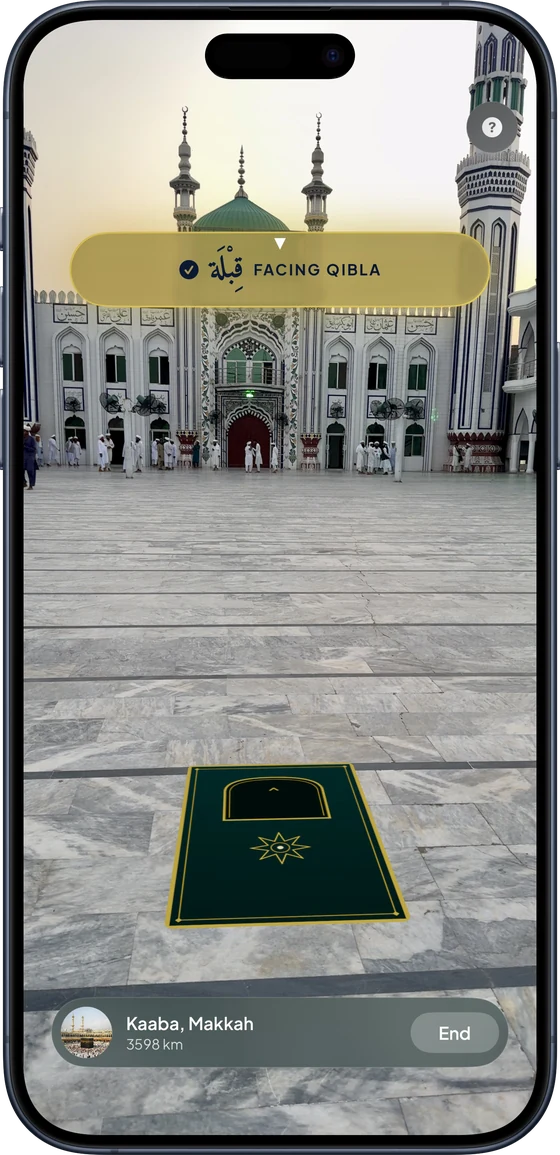
An AR Qibla view helps more than it sounds like it would. Reading "127 degrees" and translating that into a direction to point your shoulders is genuinely hard. Seeing a prayer mat laid on your own carpet, through your own camera, removes the translation step entirely.
The check that needs no technology at all
Here is the part most people have never heard, and it is the strongest verification available.
Twice a year the sun passes directly over the Kaaba. It happens around 27 to 28 May and again around 15 to 16 July. At that precise moment the sun sits at the zenith above Makkah, which means that anywhere on earth where the sun is visible in the sky, the direction of the sun is the direction of the Kaaba.
Face the sun at that moment and you are facing the Qibla. Every vertical shadow around you points directly away from it. This is called Rasd al-Qibla, and it has been used to align mosques for centuries.
To use it, check the exact time for your timezone in advance, go outside a minute or two early with a clear view of the sun, and at the moment itself note the direction your shadow falls. Extend that line backwards, indoors, into the room you pray in. It costs nothing, depends on no device, and settles the question permanently.
The shadow method, on any ordinary day
If you would rather not wait for May or July, you can still get a solid reference from the sun on any clear day, because you know two things without any instrument at all: at local solar noon the sun is due south if you are in the northern hemisphere and due north if you are in the southern, and it rises in the east and sets in the west.
Stand a straight object upright outside on level ground and watch its shadow through the middle of the day. The shortest shadow of the day marks the north to south line exactly. Once you have true north marked on the ground, you can measure your Qibla bearing off it with a protractor, and you have a reference that no magnet can disturb.
This gives you true north rather than magnetic north, which matters more than people expect. Depending on where you live, the two can differ by well over ten degrees.
Why your phone compass misbehaves indoors
If you have ever watched a compass needle swing while walking around your own flat, nothing is broken. Magnetic compasses respond to whatever metal is nearby, and a home is full of it:
- Steel in the building itself — reinforced concrete, joists, radiators, pipework.
- Electronics — laptops, speakers, televisions, wireless chargers.
- Magnets in phone accessories — MagSafe cases, magnetic car mounts and pop sockets sit millimetres from the sensor, and are the single most common cause.
Two habits fix most of it. Take the phone out of any magnetic case before checking, and calibrate by moving the phone in a figure of eight a few times. But the deeper fix is not to depend on the magnetometer at all, which is exactly what a GPS based bearing avoids.
Mark it once, and stop checking
The real goal is not to find the Qibla today. It is to never think about it again in this house.
- Establish the bearing with a GPS based app, standing in the room you pray in.
- Verify it once against the sun, ideally on a Rasd al-Qibla date, otherwise with the shadow method.
- Mark it physically. A small piece of tape under the carpet edge, a discreet mark on the skirting board, or simply squaring your prayer mat to a specific wall and leaving it there.
- Note the number down. Write the bearing in degrees somewhere you will find it. It stays valid for as long as you live at that address.
Do that once and the question is closed. It also gives you something to hand visitors, which matters more in a shared house or when family stay over.
Does the Qibla change if I move to another room?
No, not perceptibly. The Kaaba is thousands of kilometres away, so moving a few metres within a building changes the bearing by a fraction of a degree that no one could stand accurately enough to notice. One bearing serves the whole house.
How precise does facing the Qibla need to be?
The overwhelming majority of scholars hold that facing the general direction is sufficient for anyone not within sight of the Kaaba itself, and that a modest deviation does not invalidate the prayer. Aim to be accurate because it is right to try, not because a few degrees will undo your salah.
What if I am in a hotel or somewhere unfamiliar?
The same GPS method works anywhere without setup, which is exactly why it beats carrying a compass. Some hotels in Muslim majority countries mark the Qibla on the ceiling or inside a drawer, and where that exists it is usually reliable, but it is worth a quick check against your app rather than a blind trust.
 Conclusion
The direction is worth settling once
The Qibla from your house is a fixed number. It does not change with the seasons, it does not change between rooms, and once you have established it there is no reason to work it out again.
Take the bearing from a GPS based app, confirm it against the sun on a clear day, mark the line somewhere discreet, and write the degrees down. Ten minutes of care buys you years of praying without that small background doubt about whether the wall in front of you is the right one.


Keep reading

Senior iOS engineer and the founder of Athanify. Over six years he has shipped sixteen apps on the App Store to users in more than fifty countries, with deep work in Apple's Screen Time framework, payments, encryption and on device AI. He built Athanify on his own, from the first sketch to launch, and writes here about praying well in a world full of screens.