Prayer Time Calculation Methods Explained
Every prayer app asks you to pick one, and almost nobody explains what you are picking. Here is what each method actually changes, and how to choose without guessing.


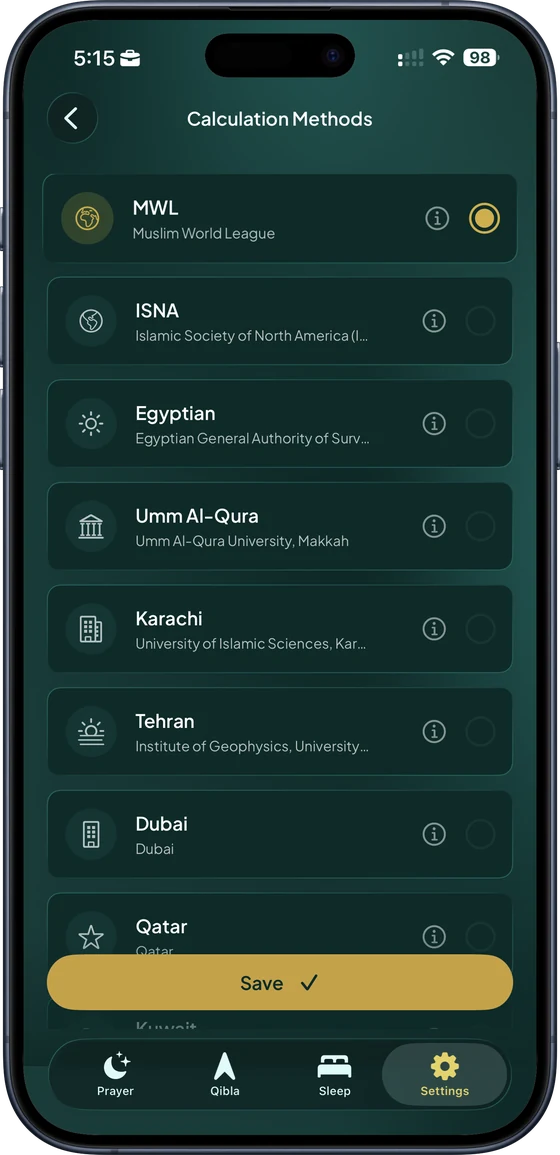
Open the settings of any prayer app and you will find a list like this: Muslim World League, ISNA, Umm al-Qura, Egyptian General Authority, Karachi. Most people pick one at random, or leave whatever the app guessed, and then wonder why their Fajr alarm is eight minutes off from the masjid down the road.
The list is not arbitrary and the differences are not bugs. Each entry is a considered scholarly position on a genuinely hard question. This is what each one means.
Only two prayers are actually in dispute
Three of the five daily prayers are fixed by something you can point at in the sky. Dhuhr begins when the sun passes its highest point. Maghrib begins at sunset. Sunrise ends the window for Fajr. These are astronomical events, computable to the second from your latitude and longitude, and no calculation method changes them by more than a rounding choice.
Fajr and Isha are different. Both are defined by twilight, not by the sun itself. Fajr begins at the first true light of dawn; Isha begins when the last of the evening glow has gone. Neither moment has a crisp edge. Twilight fades gradually, and where exactly you draw the line is a judgement.
So authorities express that judgement as an angle: how far below the horizon the sun must sit before the moment counts as arrived. An 18 degree Fajr angle means dawn begins when the sun is 18 degrees below the horizon. A 15 degree angle means it begins later in the morning, because the sun climbs to that shallower depth nearer to sunrise.
That single number is what a calculation method mostly is. A degree or two of difference translates into five to twelve minutes at the clock, more as you go further from the equator.
The main methods, side by side
These are the methods you will meet in almost every prayer app, with the twilight angles each uses.
| Method | Fajr | Isha | Commonly used in |
|---|---|---|---|
| Muslim World League | 18° | 17° | Europe, parts of Asia, a common default |
| Islamic Society of North America | 15° | 15° | United States and Canada |
| Egyptian General Authority of Survey | 19.5° | 17.5° | Egypt, Syria, Iraq, Lebanon, Malaysia |
| Umm al-Qura, Makkah | 18.5° | 90 min after Maghrib | Saudi Arabia |
| University of Islamic Sciences, Karachi | 18° | 18° | Pakistan, India, Bangladesh, Afghanistan |
| Institute of Geophysics, Tehran | 17.7° | 14° | Iran, some Shia communities |
| Shia Ithna Ashari, Jafari | 16° | 14° | Shia communities worldwide |
Two things in that table are worth pausing on.
ISNA's 15 degrees is the outlier, and deliberately so. It gives a noticeably later Fajr and an earlier Isha than the others. The reasoning is practical: at North American latitudes, an 18 degree Fajr in midsummer arrives brutally early, and 15 degrees was adopted partly so the schedule stays livable across a large, high-latitude population. Some scholars accept the reasoning and some do not, which is exactly why it is a choice in your settings rather than a setting in the app's code.
Umm al-Qura does not use an angle for Isha at all. It uses a fixed interval of 90 minutes after Maghrib, extended to 120 minutes during Ramadan. Several Gulf methods follow the same pattern. This is simpler and steadier through the year, but it means Isha drifts relative to actual twilight as the seasons turn.
Asr is a separate setting, and it is not the method
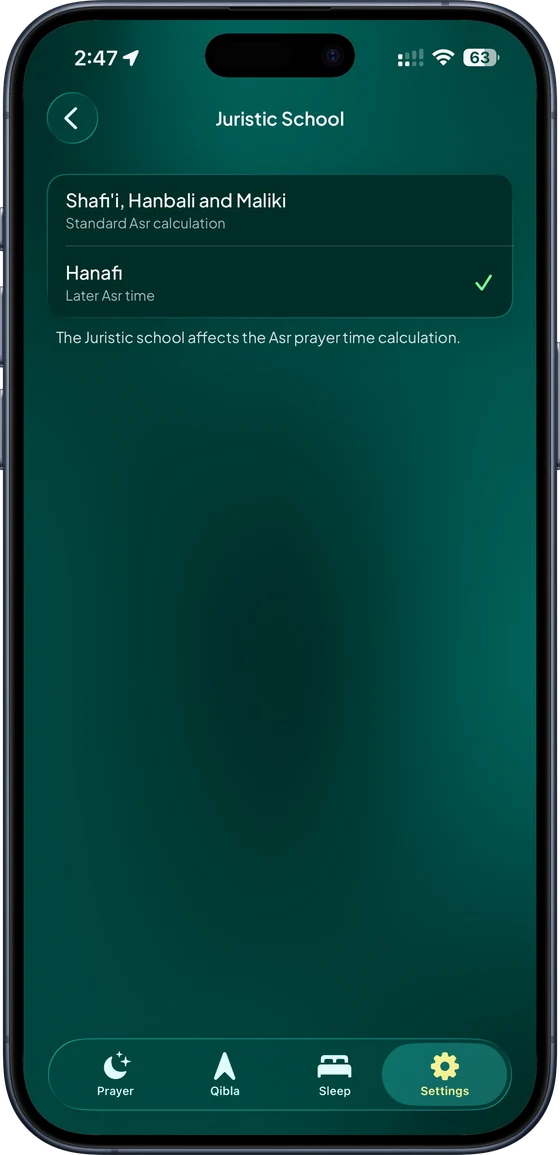
This trips people up constantly. If your Asr is an hour later than a friend's in the same city, the calculation method is almost certainly not the cause. Asr is set by madhab.
The Shafi'i, Maliki and Hanbali schools hold that Asr begins when an object's shadow equals its own length, plus the shadow it cast at noon. The Hanafi school holds that it begins when the shadow reaches twice the object's length. The second condition is met later in the afternoon, so Hanafi Asr commonly falls thirty to sixty minutes after the others.
A good app keeps these as two independent settings, because they answer two different questions. Your calculation method reflects the authority your region follows. Your madhab reflects the school you pray by. Mixing them into one dropdown is a mistake that produces wrong times for people who follow, for example, the Hanafi school in a country that uses ISNA.
High latitude is where methods break down
Every method above assumes the sun eventually reaches the required angle below the horizon. Above roughly 48 degrees of latitude, that assumption fails in summer. In northern Britain, Scandinavia, much of Canada and Russia, twilight simply never ends around the solstice. The sun never sits 18 degrees down, so there is no moment at which Fajr, computed literally, begins.
This is not a rare edge case. It affects Muslims in Manchester, Edinburgh, Stockholm, Oslo, Copenhagen, Moscow, Toronto, Calgary and far beyond. So a second rule is applied on top of the method:
- Middle of the night. The period from sunset to sunrise is halved. Isha is placed before that midpoint and Fajr after it.
- One seventh of the night. The night is split into seven parts. Isha begins after the first seventh, Fajr begins in the last.
- Angle based. The night is divided in proportion to the method's own twilight angle, which keeps it closer to the method you chose.
- Nearest latitude or nearest date. Times are borrowed from the closest point or day where a normal calculation still works.
If you live above that line, the high latitude rule can move your Fajr by more than an hour, which makes it a bigger factor than the calculation method itself. Check that your app exposes it, and match whatever your local mosque has settled on.
So which one should you pick?
The instinct is to search for the most accurate method. That question has no answer, because these are not competing measurements of one physical fact. They are different scholarly readings of when twilight has genuinely begun or ended. All are defensible; none is a bug in the others.
The useful question is different: which method does the community I pray with follow? Praying in step with your congregation is worth far more than the four minutes you might gain by picking a stricter angle in private.
So, in order:
- Ask your local mosque which method their timetable uses. Most will tell you immediately, and many print it on the timetable itself.
- If you cannot ask, use your region's convention. ISNA across North America, Muslim World League across much of Europe, Karachi across South Asia, Umm al-Qura in Saudi Arabia, the Egyptian authority across much of the Levant and North Africa.
- Set your madhab separately, according to the school you follow, not the country you live in.
- Set it once and leave it. Switching methods month to month in search of a better number is how people end up out of step with everyone around them.
What a prayer app owes you
A calculation method is a scholarly position, not a preference, and an app should treat it that way. That means recommending a sensible default for your region rather than making you guess, keeping madhab as its own separate control, exposing the high latitude rule instead of silently choosing one, and never quietly changing your settings in an update.
Athanify does all four. It reads your location and suggests the method your region conventionally follows, then gets out of the way if you want something else. If you have ever wondered why the app you were using put Fajr at a time nobody around you agreed with, the answer was usually one of these settings, chosen for you without being explained.
Does the calculation method affect Ramadan times?
Yes, and more than at any other time of year. Suhoor ends at Fajr, so your Fajr angle directly sets the last minute you may eat. Iftar is at Maghrib, which is sunset and therefore unaffected by the method. If your suhoor cutoff has ever disagreed with the mosque's timetable, the Fajr angle is where to look first.
Should I change the method when I travel?
Change your location, not your method, for a short trip, and your times will follow you correctly. If you have moved somewhere permanently, switch to the method your new community follows, since the point of the setting is to keep you in step with the people you pray beside.
 Conclusion
Set it once, to match the people you pray with
There is no most accurate method, because these are not competing measurements of a single fact. They are considered scholarly judgements about when twilight has genuinely begun and ended, and every one of them is defensible.
So the question worth asking is not which is correct but which your community follows. Ask your mosque, set the method and your madhab as two separate settings, and then leave them alone. Being in step with the congregation you pray beside is worth more than the four minutes you might gain by chasing a stricter angle on your own.


Keep reading
All articles in the Journal →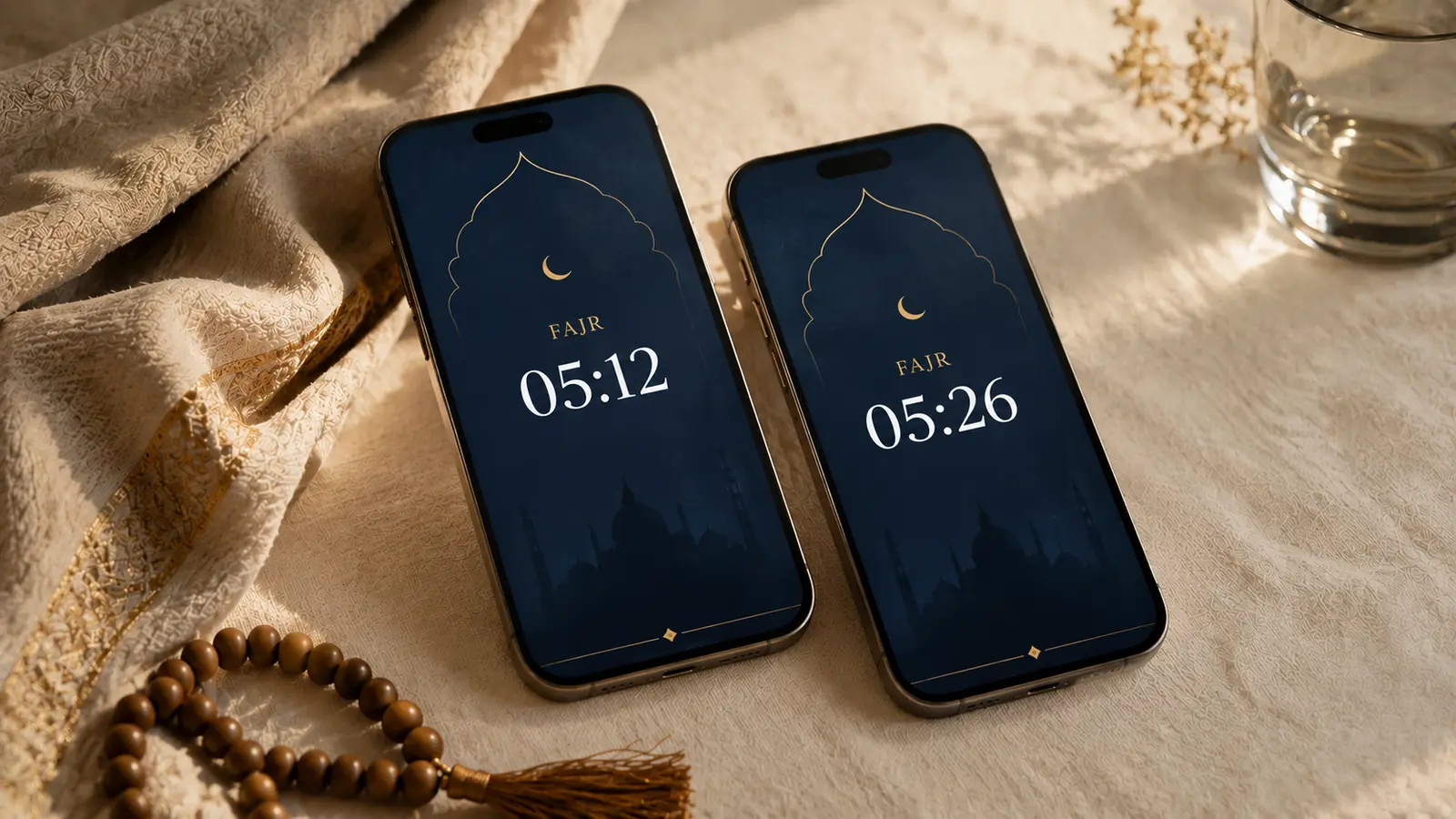
Senior iOS engineer and the founder of Athanify. Over six years he has shipped sixteen apps on the App Store to users in more than fifty countries, with deep work in Apple's Screen Time framework, payments, encryption and on device AI. He built Athanify on his own, from the first sketch to launch, and writes here about praying well in a world full of screens.